Precise
Every tube within a degree of the others.
A probe and a fast controller keep all sixteen tubes on target.
Hot-air PCR thermocycler
PCR that runs on hot air. Sixteen tubes, built for FAIR data, easy to repair and extend. The parts cost about $250.
How it works
Seven parts and no metal block.
A heat-gun element warms the air.
A mixer blends the air, so there are no hot spots.
A bundle of straws calms the flow.
The air sweeps past sixteen PCR tubes. One of them holds a thermal probe.
A fan keeps the air going round.
To cool down, a flap opens and lets room air in.
A microcontroller reads the probe ten times a second and steers the heater, fan and flap.
One cycle
PCR copies one piece of DNA. In each cycle the tube goes through three temperatures, and a full run is about 30 cycles.
Performance
Lab cyclers cost $4,000 to $14,000. AirPCR's parts cost about $250.
| Machine | Tubes | Full PCR | Price |
|---|---|---|---|
| AirPCR | 16 | 38min | ≈ $250 |
| Eppendorf X50s | 96 | 24min | $13,326 |
| Bio-Rad T100 | 96 | 27min | $9,794 |
| miniPCR mini8X | 8 | 30min | $499 |
| miniPCR mini16X | 16 | 31min | $860 |
| Bento Lab Pro | 32 | 31min | $2,100 |
| Thermo Fisher ProFlex | 96 | 25min | $14,050 |
| Chai Biotechnologies Open qPCR | 16 | 26min | $1,500 |
| Benchmark TC-32 Mini | 32 | 26min | $3,437 |
| Thermo Fisher SimpliAmp | 96 | 28min | $5,420 |
| Thermo Fisher MiniAmp | 96 | 31min | $4,135 |
| miniPCR mini16 (older) | 16 | 35min | $1,512 |
| GaudiLabs PocketPCR | 5 | 52min | $109 |
| Chai Biotechnologies OpenPCR | 16 | 53min | $649 |
AirPCR's price is the cost of its parts; the others are retail prices.
Price:
Time:
AirPCRteaching / DIYlabHover a dot for details.
Precise
A probe and a fast controller keep all sixteen tubes on target.
Robust and repairable
No Peltier element. Every part can be bought and swapped.
Quick
Air changes temperature quickly, so the run moves fast from step to step.
Open, FAIR data
The full temperature curve, so you can see how your PCR went.
Give the run file to an AI assistant and ask whether the run went well.
Findable, accessible, interoperable and reusable. Made to connect to lab software and robots.
"device": "AirPCR",
"program": "colony PCR, 30 cycles",
"curves": { "sample": [72.0, 72.4, …], "air": […] },
"result": "every step on target",
"license": "open"Who it's for
Teaching labs
Cheap enough that a class doesn't have to share one.
Makers & DIYbio
Repairable by design, with parts that are easy to find.
Automated labs
Designed with open connections for lab software and automation.
Research labs
Run data comes out in open formats, ready for your pipeline.
Roadmap
Q3 2026 · done
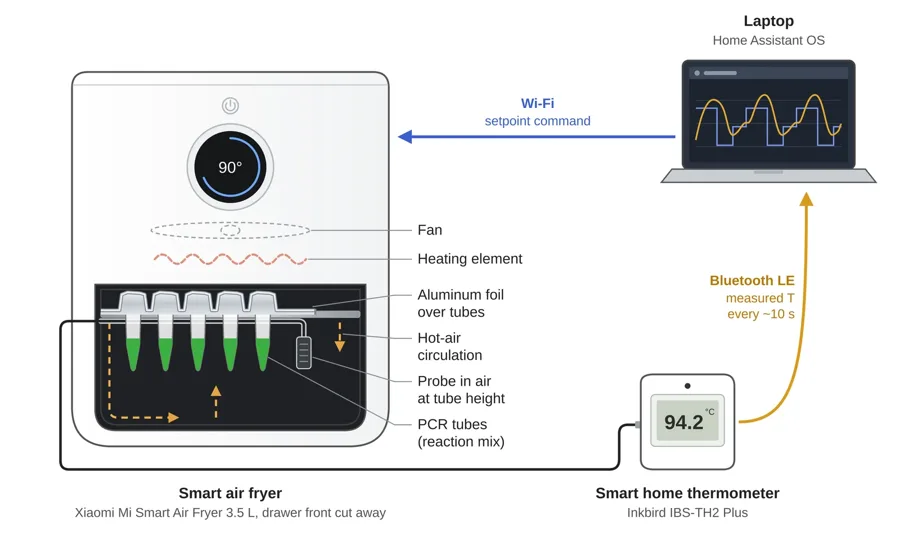
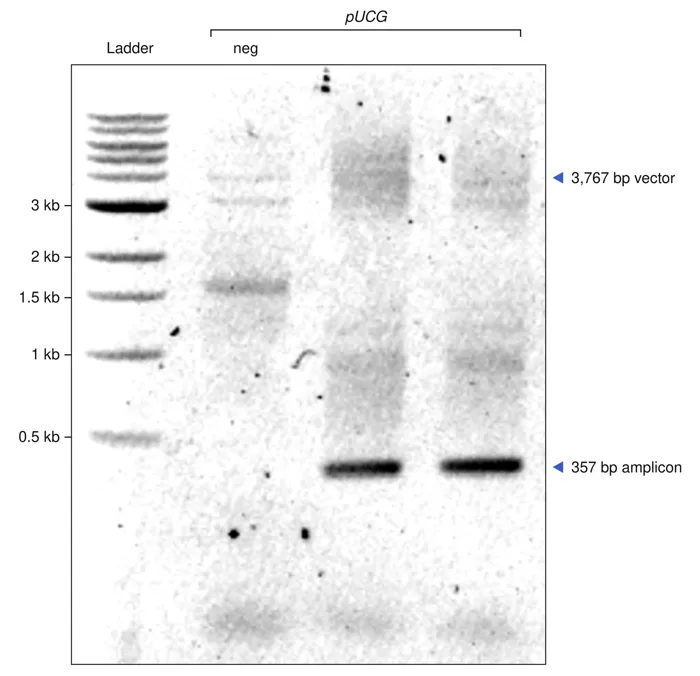
A kitchen air fryer ran a real PCR, with a confirmed result.
Q4 2026 · done
We designed the machine in a physics model and tried thousands of versions.
Next
Build it, test it, run real PCR on it.
Then
Open, FAIR data that AI can read, and links to lab automation.
Later
A first small batch for labs and early users.
Research
Thin glass tubes for even faster runs.
Get in touch
We're building the first units, and we're looking for investors and early users.